- Diese Veranstaltung hat bereits stattgefunden.
Shifts to the right – Questions of alliances and what to do in music scenes
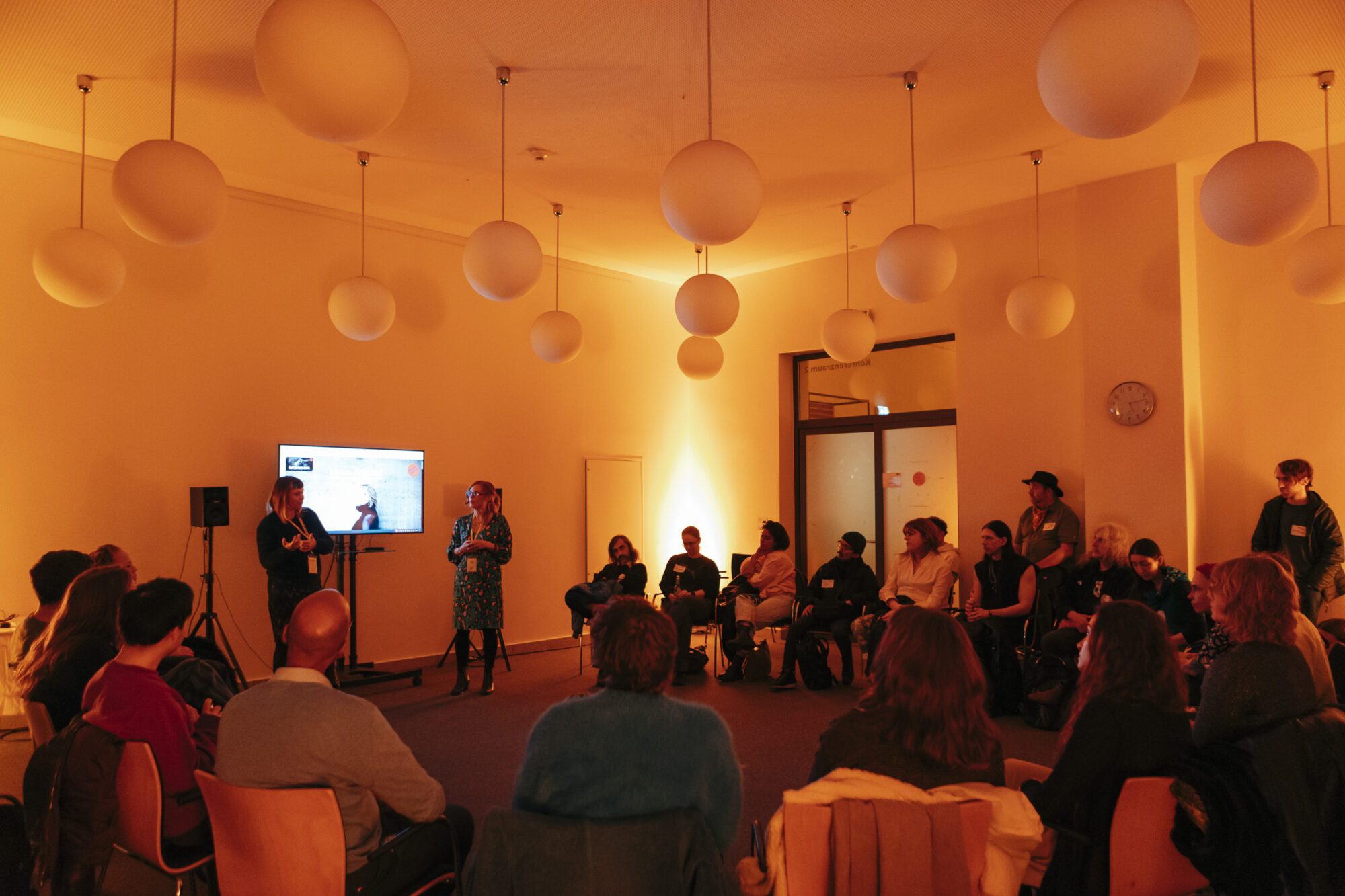
Taking an incident of right-wing vandalism at a music/cultural space in Schöneweide as a starting point, we want to open a conversation on how we as music scenes deal with current moves to the political right and cultural infrastructures under pressure. We are particularly interested in the question of alliances — how they are built, where they fail, and what they require at this moment. We would like to engage in a conversation that starts off with invited guests and then opens up into a collective conversation and exercise of sharing and mapping of experiences, questions, examples, and initiatives.
To start with, the percentage of the population in Germany that supports fascist ideas has grown, including in youth and music cultures. Where do we as music scenes interface with these developments? Are there more examples of right-wing attacks, and what do support, solidarity, and alliances across scenes and communities look like in these cases? Can music also be a way to work with youth so they don’t join fascist groups in the first place, and what are examples?
Then, there is the shifting of political agendas and overall discourse, which materializes e.g. in shifts of public funding away from culture and social causes in general, and in cases of defunding and cancellations specifically. At the same time, prices are rising, and AI is writing the next 10K songs. Leftist scenes are fractured, and wars and violence leave many people grieving and exhausted. How do we as scenes respond to cultural infrastructures under pressure and sustain and build music cultures at the current moment? Where do we see our roles (“we” being very different perspectives also in the different scenes)? Who is particularly at risk? And crucially: how can alliances be built or rebuilt across differences, disciplines, and communities? What can we learn from existing practices of organizing, solidarity, and long-term coalition building?
And then, there is also the music itself in this moment – What about protest songs and ways of artistic interventions? What about music as a space to bring different people together — not only symbolically, but as a site of real alliance-building? How does music contribute to activist and social organizing? What are ways of dealing with the moment in an antifascist way, with our practices, and within and across our scenes?
Panelists:
Ariel William Orah is an Indonesian artist and community catalyst based in Berlin. Orah’s interdisciplinary practice critically engages with systemic structures while addressing the emotional and cultural dimensions of displacement and identity. Working across performance, sound art, and socially engaged projects—with a keen focus on social and climate injustice—Orah co-founded the collaborative platform and art group sōydivsion, the think-tank initiative Mutating Kinship Lab, and the empathy-driven sound collective L-KW. (arielorah.com)
MALONDA is a very versatile and outspoken artist on the current music scene. The Berlin-based singer and ‘electronic diva’, who writes her own songs and also shines on the theatre stage, consistently tackles anti-racist and queer-feminist themes. With her highly acclaimed debut album *Mein Herz ist ein dunkler Kontinent* and appearances at festivals such as c/o pop, Pop-Kultur Berlin and the Reeperbahn Festival, she has made a name for herself in the music world. As a Black queer-feminist, MALONDA also shares her perspectives through panel discussions, texts and workshops, and is working to embed intersectional approaches more firmly within the German discourse. (https://www.youtube.com/@FrauMalonda)
Simon Knop Jacobsen is a cultural manager based in Potsdam, Germany. He works at ImPuls Brandenburg, the state association representing socioculture, popular music, and festivals, where he is responsible for the festival sector. In his role, he supports and advocates for the development and sustainability of festival culture across the region. He is also the organiser of Forum KulturSichern, an initiative dedicated to improving the conditions in which cultural events are organised and strengthening their protection and resilience.
https://www.impuls-brandenburg.de/forum-kultursichern/
Adam Cooke, originally from Dublin, Ireland is a Berlin based DJ, radio host and activist who has been involved with Refuge Worldwide since 2022 and joined the team in 2024. Music is central to his activism and believes strongly that culture can be a key catalyst for change.
DJ:
Pisitakun Kuantalueng is originally from Bangkok, Thailand, and started making visual arts and music in 2014. Blending historical events and political speculation with synthetic textures and traditional instruments, his sound confronts both external control and the inner unrest faced by artists. He questions fundamental and increasingly universal values without simply decrying corruption or offering neat solutions. Pisitakun initiated the project “Three Sound of Revolution”, concerned with music and political protest, while a DAAD music and sound fellow, 2023. https://threesound.org/
This evening is organized by Music Pool Berlin in collaboration with Moving Poets Berlin and sōydivision.